Tankless vs Tank How to Choose a Reverse Osmosis Water Purifier?

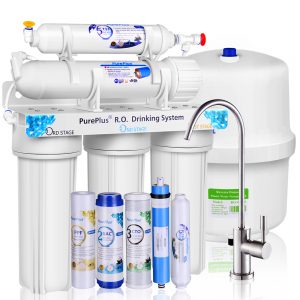
There are two types of reverse osmosis water purifiers on the market today, namely a tank reverse osmosis water purifier and a tankless reverse osmosis water purifier. Faced with these two types of reverse osmosis water purifiers, I believe everyone will be confused when choosing. So how do you choose between these two types of reverse osmosis water purifiers?

The difference between tank reverse osmosis water purifier and a tankless reverse osmosis water purifier

There is a tank reverse osmosis water purifier with a pressure tank, which is mainly used in closed water circulation to balance the water volume and pressure. The existence of the pressure tank can avoid the frequent opening of the safety valve and the frequent replenishment of the automatic water replenishment valve, extending the service life of the water purifier. In addition, the pressure tank can also solve the pure water supply when the user’s home is stopped.

The tankless reverse osmosis water purifier does not have a pressure tank, which releases the space under the kitchen, and solves the pain point of slow water production with tank reverse osmosis water purifiers, realizes instant filtering and drinking, and solves the possibility of secondary pollution in the pressure barrel Hidden problems.

Comparison of the advantages and disadvantages of tank and tankless reverse osmosis water purifiers

Occupied Space

Area with tank VS Area with tankless reverse osmosis water purifiers

Compared with the tankless reverse osmosis water purifier, the tank reverse osmosis water purifier has an extra pressure barrel, so in terms of floor space, the tank reverse osmosis water purifier will be larger than the tankless reverse osmosis water purifier.

Noise Level

With tank noise VS Tankless reverse osmosis water purifier noise

Reverse osmosis water purification technology requires a water pump to make water. Some tank machines have pressure barrels. After a full tank of water is made, the water purifier will stop working. The machine will not start to make water until there is almost no water in the tank. Water, so the requirements for the power of the pump are not high. The reverse osmosis membrane used in the tankless machine is above 400G. Therefore, the power of the pump is correspondingly larger. The greater the power of the pump, the greater the noise. This is why some tanks of tankless machine shells are pasted with a thick layer. The reason for the sound insulation cotton.

Water Speed

Water outlet with tank VS Water outlet without tank

There are tank machines because the prepared water is stored in a pressure barrel in advance, and the water in the pressure tank  can quickly come out when drinking. Although the Tankless reverse osmosis water purifier produces water faster than the tank machine, no matter how fast it is, it is faster than the tank machine. Because the tankless machine is instant filter and drink, it has to pass five filtration levels at one time, while the barrel machine only needs to pass one filtration level. Relatively speaking, the water output speed of the barrel machine is better than the water output speed of the tankless RO system.

Failure Rate

Failure rate of machine with tank VS failure rate of machine without tank

The tankless RO system can start the machine as long as the faucet is turned on, and the frequent start of the machine will accelerate the aging of internal electrical components. In addition, the working current of the tankless RO system is 3-4 times larger than that of the tankless machine. The working frequency of the pressure switch contacts of the machine is quite high. For this reason, the probability of failure has also become greater. Because the tank machine does not need to be started frequently, and the working current is small and stable, the failure rate is relatively low.

Hygiene Issue

Tank RO system VS Tankless RO system

The pressure tank with RO system is a closed structure, if it is used for a long time without replacing it, it will easily induce secondary pollution. Since the tankless machine does not have a pressure tank, there is no need to worry about whether the pressure tank will produce secondary pollution. Of course, as long as the pressure tank is maintained well, the problem of secondary pollution of the pressure tank can be avoided, because the pressure tank is in a vacuum state, in this state, bacteria cannot survive.

Price

Tank reverse osmosis water purifier price VS Tankless reverse osmosis water purifier price

The price of the tankless machine is more expensive than the price of the barrel machine. Because the tankless machine needs to filter and drink immediately, and it is frequently turned on, the material used for the tankless machine is better than that of the tankless reverse osmosis water purifier. In addition, in terms of the cost of replacing the filter element, the tankless machine is more expensive than the barreled machine, because the reverse osmosis membrane of the tankless machine will be larger than the barreled machine, which is why the tankless reverse osmosis water purifier is faster than the barreled machine.
What Kind of Water Purifier can Drink Water Directly

The water filtered by the reverse osmosis water purifier can be drunk directly

Among the current various water purifiers, the water purification capacity of reverse osmosis water purifiers are relatively high.

The reverse osmosis water purifier can remove 99% of viruses and heavy metals, soften the water quality, and make the tap water reach a level that can be directly drunk. Note that not all water purifiers are reverse osmosis, so be sure to check before buying.

The reverse osmosis water purifier uses an RO reverse osmosis membrane. Compared with the general water purifier, this reverse osmosis filtration method has a filtration accuracy of 0.0001 micron. It can easily filter most of the impurities in the water, including bacteria, residual chlorine, colloids, organic matter, pesticides, inorganic salts, heavy metals, etc. The filtered water can be directly consumed, so the reverse osmosis water purifier is also called a pure water machine.

A. Generally, tap water contains a lot of harmful substances, some of which are difficult to remove even if boiling. The reverse osmosis water purifier has a stronger purification ability and can effectively filter bacteria, viruses, and odors in the water. The filtered water can be directly purified by pure water. drink.

B. The reverse osmosis water purifier is equipped with activated carbon filter element, which has a good effect of removing and adsorbing different colors and odors in the water, and the water taste is more sweet.

C. The water purified by the reverse osmosis water purifier can be stored for a long time without scale. Because the water is clean, the water purified by the reverse osmosis water purifier has a caring effect on the skin.

Choose a Certified Water Purifier

There are so many brands of water purifiers, and the product quality is uneven. How can we choose a high-quality water purifier? While understanding the concept and technology of water purifiers, the quality assurance of third-party certification is also very important.

EU Drinking Water Standard

Everyone knows that in many EU countries, the tap water in the tap can be directly drunk. It can be seen that EU countries have high control over drinking water safety. If the water quality filtered by a water purifier can meet the EU drinking water standards, it reflects the excellent filtering effect of the water purifier.

NSF Certification

In addition to the water quality that meets the EU drinking water standards, there is also a leading and independent professional organization that provides certification and testing of water quality and food safety products in the world-NSF.

NSF was established in 1944, and it was selected by the World Health Organization as a cooperation center for drinking water safety and treatment. NSF is very strict in the testing and certification of water purifiers. It also conducts periodic inspections on the brands of tested products and maintains follow-up supervision of the manufacturers, which can be said to be “lifetime” supervision.

Obtaining NSF certification means that the water purifier product has obtained international recognition and is a strong proof of high-quality products.

WQA Certification

There is also a high-quality symbol and logo in the field of water purifier products, that is WQA (Water Quality Association of America) certification.

How to replace our refrigerator water filter ?

Our refrigerator water filter can remove a miraculous number of contaminants from our water, it can be a powerful tool that guarantees we have the safest, freshest water possible.The purity of the water we drink is paramount to our health.To ensure we have the most purified water is to change our refrigerator water filter every six months or when we notice a change in the taste or smell of our water. It is recommended by most experts and refrigerator water filter manufacturers. Of course, this rule of thumb might vary depending on use. If our family uses a heavier than average amount of water, over time our refrigerator water filter will collect filtered out contaminants that will diminish its effectiveness and the quality of the water, our old refrigerator water filter may actually be growing bacteria and mold.Overall, the most effective way to to tell if you need a filter change is by taste or odor.The type of contaminants reduced by a properly functioning filter will appear more and more as your filter ages.Sooner, if your water is starting to taste a little funny.If your refrigerator’s warning light is on, then it”s time to replace it. Each manufacturer’s refrigerator water filtration system is a bit different though. In most cases, changing your refrigerator water filter is fairly simple.Many manufacturers have taken steps to ensure that their filters are easy to access and replace. You should consult your owner’s manual to locate the filter, and follow the directions for removing and replacing it. Let”s take refrigerator water filter as an example, replacement steps are below: Step 1 On models without a replacement indicator light, apply the month sticker to the new cartridge and mark your calendar to remind you to replace the filter after six months.Step 2 Remove old filter cartridge by grasping and turning to the left about 1/2 turn.Step 3 Remove the protective foil from the end of the new filter. Fill the replacement filter with a little water from the tap to allow for better flow immediately after installation.Step 4 Place the top of the new cartridge up inside the cartridge holder. Slowly turn the filter to right until the filter cartridge stops. Do not over tighten. As you turn the cartridge it will automatically raise itself into position. The cartridge will move about 1/2 turn.Step 5 Run water from the dispenser for 6-8 minutes (about 3-4 gallons) to clear the system and prevent sputtering.Step 6 On models with a replacement indicator light, press and hold the RESET WATER FILTER PAD on the dispenser.Caution: Do not use with water that is microbiologically unsafe or unknown quality without adequate disinfection before or after the system.If you have questions about what your water filter is doing for the water in your home, feel free to browse through the Refrigerator Water Filter section of our online store or call us directly at 0086-16622909012

Water Purifiers Diary

I (Water purifiers) have been here for several months and won appreciation by many partners. I feel very proud. I have a lot of “core words” to say.First of all, I”m quite self-appreciation, one of the reasons is my beautiful appearance, white fuselage with blue water, simple but atmospheric. I would also like to thank the great designers for their tailor-made fresh style, which is inspired by the waterfalls of nature!In addition to the appearance of beauty, what makes me more confident is the powerful function of different filter cartridges. I always remember their sayings in “core”!

water purifier

Using 100% food grade polypropylene (PP) as material, the filter cartridge contains no wetting agents, solvents agents, antistatic agents or binders.By special production technology to control the diameter of PP fiber, the micron rate of filter cartridge is controlled. Removing efficiency can reach 99% above.The surface layer of the filter cartridge is designed to be low density to assure the high-holding capability, while the inner layer is higher density to keep the accurate filtration ability to small particles. The density type is 30% higher filtration effect than the general type.I am in charge of the task of filtering out large pollutant particles such as residual sediment, rust, suspended material and impurities in the water.

water purifier for home

 Using Nylon as the material, Nylon melt blown filter cartridge has high resistance to acids, alkalis and high temperature. The micron rate is controlled by adjusting the diameter of the Nylon fiber.I swim freely in the water, I have cleanliness, residual chlorine, color and smell in my side nowhere to hide. 

water purifier companies

Using 100% food grade polypropylene (PP) as material, the filter cartridge contains no wetting agents, antistatic agents or binders; Each micron rate has its string pattern to ensure the filtration effect. The filter cartridge has a better dirt-holding capability than the general PP sediment melt blown filter cartridge. Apply to liquid filtration in the fields of petroleum, chemical, electronic, electronic, electroplating, medicine and food production.I have a very broad range of USES, enabling me to rank ahead in all industries. PP line and PP skeleton constitute our flesh and blood body, giving us the sacred mission of adsorption andpurification.

Questions and Answers in Water Filtration Work Line

Many families do not install the reverse osmosis system not because it is expensive, but not sure whether it is value for money, and there are many problems are not very well understood, so most families hesitate to install reverse osmosis system. Now, I have summarized several core questions that everyone pays attention to before installing reverse osmosis system, so that friends want to install reverse osmosis system and are in hesitation come to reference.1.Is the reverse osmosis system too expensive for ordinary families?It costs 1-2 US dollar per barrel to replace a barrel of water in 5-6 days. It costs about 100 US dollar per year, which is enough for a reverse osmosis system in only a few years. While the bottled water usually has a guarantee period, so choose reverse osmosis system you will drink safe, healthy, fresh, quality water anytime to improve the quality of kitchen! Whether you make soup, cook or brew tea & coffee, it will be healthy and tasty! And it helps you save the troublesome steps of ordering and carrying. 2.Can you install reverse osmosis system when the decoration is finished?Usually, we suggest that users plan the reverse osmosis system line before remodeling, so as to avoid the inconvenience of water and electricity in installation. In fact, most of our clients are families that install reverse osmosis system after remodeling for long time. Our installation professionals will install a switch tee at the kitchen outlet and fix the direct drinking water system to the side of your kitchen cabinet or under the cabinet. Installation is simple and quick, and will neither affect the use of original kitchen faucet, nor destroy the original decoration. 3.Must the location or pipeline be reserved for the installation of the reverse osmosis system?In principle, our company has good after-sales service, these problems are easy to de solved, our installation professionals will help you to deal with the water and electricity lines. The installation of drinking water filter product is flexible and simple, it only occupies a small space inside the cabinet below your sink, and install the purifier by using the soap dispenser reserved by the sink or directly punch holes on the sink. You can buy a water purifier as long as finishing installing the cabinets and sinks! 4.When should the filter cartridges be replaced?About 2600 mgs of rust a year, 26,000 mgs in 10 years;About 9,600 mgs of organic matter (diqian pesticide) a year, and 96,000 mgs in 10 years (two pesticides);About 500 mgs of sediment per year, 5,000 mgs in 10 years;About 4 mgs of lead a year, 40 mgs in 10 years.The plugged filter cartridge is a good one . When the filter cartridge is gradually blocked and the output water becomes small, we will suggest you to replace the filter, which also shows that the water machine is really effective! The replacement frequency of the filter is different due to the selection of products, water consumption and local water quality. Usually, the filter should be replaced every six months.best reverse osmosis system 5.What are the functions of reverse osmosis systems?(1) remove rust and chlorine from tap water and provide sweet and delicious drinking water;(2) remove harmful pollutants not seen in tap water, such as heavy metal ions, volatile organics, carcinogenic substances, etc.;(3) avoid secondary pollution of bottled water;(4) keep beneficial elements such as minerals in water.The water in the human body is renewed every 5 to 13 days. If 70% of the water in the human body is clean, then the cells in the human body will have a healthy and fresh environment. Healthy, clean water can enhance the immune capacity of human body, it is helpful for promoting cell metabolism, so the cells in the body also lost the condition of malignant transformation and toxin spread. The chance of getting sick naturally decreases. Experts tell us that while we are looking for a doctor, we should also pay attention to the continuous supply of good water to the cells, and make an effort to create a clean and healthy living environment for the cells.Healthy, clean good water, start from a high – quality reverse osmosis system !

Types of Coffee Pots and Coffee Maker Water Filters

Coffee Pots and Coffee Maker Water Filters: Many coffee fans are no longer satisfy with the taste of instant coffee. They want to have their own coffee maker to make and enjoy coffee in the office or at home. However, due to the wide variety of coffee machines on the market, many customers have no idea on how to choose a coffee machine suit for themselves. This article introduces several common coffee appliances for beginners.Catalogue.

  • American drip kettle
  • French Press
  • hand press filter cup
  • Syphon
American drip kettle 

Introduction: Automatic coffee machine is a classic drip filter. When the power is on, the high heat element in the coffee pot will quickly heat a small part of water to boil which flowing from the water storage tank. The steam pressure pushes the water out of the pipe in turn, and after passing through the distribution board, it is evenly dripping into the filter of the coffee powder, and then flowing into the coffee bottle, which becomes the drinking coffee. Insulation board at the bottom of the coffee bottle can make coffee in a temperature of 75 ℃ or so.Features: simple, efficient, reliable, it is best for home, office and dormitory, especially super lazy.Taste: coffee tastes fresh and flat.

French Press 

Introduction: Originating in France around 1850, a type of simple bubbler consists of a heat-resistant glass bottle body and a metal strainer with a pressure bar. At first, it was mainly used for brewing black tea, so some people called it tea punch. The principle of making coffee is releasing the essence of coffee by soaking the water in full contact with the coffee powder.Features: easy to operate, simple, quick and easy to master. It”s also suitable for office friends.Taste: perfectly reflects the flavor of single-origin coffee.

hand press filter cup 

Features: simple and convenient. It”s also suitable for office friends and casual friends at home.(The taste of coffee is very demanding.)Kit: hand – press, filter paper, filter cup, conical pot.Taste: perfectly reflects the flavor characteristics of coffee.

Syphon pot 

Introduction: Syphon, commonly known as “glass ball” or “siphon”, is a simple and easy coffee brewing method. It is one of the most popular coffee cooking method in the cafés. Although the syphon pot has another alias of “Sealing style”, it has nothing to do with the siphon principle. Instead, it uses heat expansion and cooling principle, when water is heated to produce water vapor, it will push the hot water from the lower sphere to the upper pot, and water will be suck back after the pot cools down. Then a cup of pure coffee is ready.Features: Suitable for people with romantic feelings and are leisurely at home.Taste: Siphonic coffee is a favorite of many coffee fans. Some people say that because it can extract the most perfect part of coffee, especially the refreshing and bright acid in the characteristics of coffee beans, and the acid is with a mellow smell. Siphon cooking can make this coffee characteristics fully realized. Moka potIntroduction: Divided into upper and lower parts, the water is boiled in the lower part to produce steam pressure. When boiling water rises, passes through the upper part of the filter pot containing coffee powder; Then turn the firepower down until the coffee flows into the upper part.Features: The operation is relatively simple and convenient. (Moka pots are based on high pressure principle to extract the coffee, so don”t buy very the cheap ones in case of any danger). It also suits for people who like espresso.Taste: The coffee has mellow and rich taste and is slightly bitter (if there is a burnt smell, then you have overcooked). Espresso coffee machineIntroduction: Making a perfect cup of Espresso or Cappuccino coffee requires a dedicated coffee machine, which is the espresso coffee machine. It uses a high temperature vapor, 9 atmospheres and 90 degrees Celsius to rapidly extract 30 milliliters strong coffee liquid in a short time of 24 seconds.Features: Espresso coffee machine can be divided into: semi-automatic and fully automatic. Simply speaking, a semi-automatic coffee machine is an espresso machine that needs to be grinded and filled by yourself. The coffee quality will vary depending on the operating people. The automatic machine is automatically completed from grinding to coffee. The quality of each cup is relatively balanced, but the taste is slightly inferior to the semi-automatic espresso machine.Taste: Condensation with scent and tasty, the intake of caffeine is reduced greatly. AeroPressIntroduction: AeroPress produced a big reaction when it entered into the market. It simply appears to be an improved filter press, in fact, it adds filter paper to make the filtered coffee very clean. In addition, it has piston which can cause a little pressure and increase the extraction rate. If you want to have a cup of espresso in the office, Aeropress may be a good choice.Features: The coffee concentration from Aero Press is quite flexible. Putting less water or more powder, your coffee will be much concentrated. I like to use it to do a simple coffee quality test: use it to make “espresso”. Strictly speaking, it is just very concentrated coffee, which could not be called as espresso. It is so rich that it’s no problem to be a base of latte coffee for household users.Taste: AreoPress can cook a very strong coffee base, but it does not lose its rounded, thick, clean taste. Capsule Coffee MachineIntroduction: The capsule coffee machine is a new type of coffee machine appeared in recent years. The so-called capsule coffee machine is that the manufacturer pre-fills the coffee powder into a plastic capsule and then fills it with nitrogen to keep it fresh. When we want to drink coffee, we can quickly put the capsule into the coffee machine, then the fragrant coffee can be made instantly.Features: Easy to operate, any beginner can easily make a cup of espresso coffee. You can choose different flavors of coffee capsules according to personal taste. No need for cumbersome cleaning, you just need to recycle the capsule directly after making the coffee. It’s professional. Under the protection of the completely sealed nitrogen-filled package, it can effectively keep the coffee fresh and prevent oxidation, so that the storage period can reach 2 years. It can be directly put into the machine without unpacking, and it is easy to recycle after cooking.Taste: Capsule coffee is on the same production line and automatic filling, so that it can guarantee the quality of each cup of coffee is stable.We have known many coffee machines, then I will introduce you to the coffee machine water filter. Water quality is one of the factors affecting the degree of coffee, and the coffee machine filter can be said to be indispensable for the water quality. Let’s take a look at its power.Yunda coffee machine water filter has passed the NSF certification of the United States, and has excellent functions of adsorbing residual chlorine, odor, pigment, removing organic compounds. It has high filtration efficiency, good adsorption performance, non-toxic and harmless, safe and secure.

What do Activated Carbon Filters Remove?

Activated carbon filters are best at removing chlorine and bad tastes or odors, but may be certified to remove other contaminants. Look for the NSF certification on a carbon filter to find out exactly what it’s capable of removing.
Bad tastes and odors? YES
Chlorine? YES
Trihalomethanes (THMs)? YES
Mercury? YES
Pesticides and herbicides? YES
Iron or heavy metals? If certified
Lead? If certified
Bacteria? If certified to remove coliform
Hard water? NO
Fluoride? NO
Total dissolved solids (TDS)? NO
Dissolved minerals like calcium and magnesium sail right through a carbon filter. However, a carbon filter with a pore size smaller than one micron can remove coliform, cysts, lead, arsenic, or iron and other heavy metals through mechanical filtration. Even though these contaminants don’t adhere to the carbon, they cannot fit through the small pores. 
Often materials are added to carbon to improve its reduction capabilities. Adding silver to carbon creates a media that kills bacteria. Iron-reduction carbon includes KDF (Kinetic Degradation Fluxion) media made of ground copper and zinc to create a chemical reaction. The KDF converts heavy metals from a ferrous (dissolved) to a ferric (solid) state to capture the solids in the matrix of the carbon. Although certain carbon blends can reduce coliform, a UV system disinfects bacteria-infested water most effectively.

Is it Effective to Use TDS to Measure Water Quality?

TDS is an aggregate measurement of all the organic and inorganic material present in a sample of water. This includes dissolved organic compounds, inorganic compounds, salts, minerals, and ions.
 TDS meters measure the conductivity of the water in parts-per-million (abbreviated as ppm), which is equivalent to measuring the mass of contaminants present per liter of water (abbreviated as mg/L). 
 If your TDS levels are above 600, or even in the 1,000s, it is a huge indicator that there is a wildly problematic level of dissolved material present in your water. But if your water’s TDS measures between 300-500, it is considered acceptable and it’s difficult to isolate if any of those dissolved materials are potentially harmful or damaging from a TDS reading alone. 
Is it effective to use TDS to measure water quality?
TDS is a popular water quality measurement because it’s simple, accessible, and does provide the reader with a general understanding of their water’s make-up. If the TDS meter returns a 2,000ppm reading, your water is brimming with dissolved solids, many of which are likely to be undesirable contaminants. If the TDS meter shows a reading of 100, you know your tap water is generally low in organic and inorganic compounds and lacking high mineral content.
However, a TDS reading is also a common water salesman trick. If a homeowner is shown a 300ppm TDS reading and told their water is full of dangerous and unknown dissolved substances, this can be used to leverage the sale of an unnecessary and expensive water filtration system. The truth is, a TDS meter alone cannot provide the salesman or the homeowner a complete picture of the water’s quality. A more in-depth water test kit can provide a much more complete picture of what is present in your water. Some specialized tests can be performed at home, and give you estimated ranges of specific contaminants like copper or arsenic. A lab test kit will give you a complete assessment of the contaminant levels present in your water. 

Article Source: YUNDA FILTER

Why Install Whole House Water Filtration

The whole house water filtration system is an overall water treatment system that can treat domestic water and drinking water separately. This not only ensures the purity of drinking water at the entrance, but also the health of water for skin contact and equipment.
Although the quality of the water we drink from the water plant is basically guaranteed, when the tap water passes through various pipes, aging water pipes, rust-containing water towers, water tanks, etc. inevitably bring secondary pollution to the water. These will breed bacteria and contaminate drinking water. Again, although in order to eliminate these germs in the water, we have added chlorides to the water, and excessive chlorides can easily cause many diseases.
In addition to water pollution, water hardness is another indicator of water quality. Water hardness generally refers to the concentration of calcium and magnesium ions contained in the water. The main manifestation of hard water is that there are many impurities in the water, easy to form scale, heavy metals and disinfectant residues.
The hazards of hard water are manifold. In fact, the scale in the kettle is a direct manifestation of hard water. Faucets, sanitary ware, etc. are also prone to water stains and spots. Water heaters, floor heating, dishwashers, electric kettles and other electrical appliances will increase the accumulated scale due to the high content of calcium and magnesium ions in the hard water, resulting in a decrease in heat exchange efficiency. Secondly, in our daily laundry process, in order to achieve the same cleaning effect, hard water needs to use more detergents than soft water, and the clothes after washing are prone to become brittle and hard, which damages the life of the clothes. The more serious hazard of hard water is to affect health. In daily body and skin cleaning, hard water will give the skin a feeling of dryness and tightness due to high calcium and magnesium ions. For people with sensitive skin, hard water will bring more burden to the already sensitive skin. It is more likely to cause skin problems. Like skin cleansing, shampooing with hard water will also affect hair quality. In addition, hard water can cause harm to the health of the whole family. Hard water makes the skin no longer smooth and delicate, and makes the hair yellow and withered. What is more serious is that long-term consumption or use of hard water can greatly increase the incidence of various stone diseases in the body.
It is for the above reasons that more and more families choose kitchen water purifiers. However, a problem that everyone often overlooks is that drinking water purification is only the first step in healthy drinking water, and only whole house water filtration can completely solve the water quality problem. Why is whole house water purification so important?
The water purifiers we usually use can only solve drinking water, and the whole house water filtration breaks the net drinking water restriction of a single scene and equipment, and can provide clean drinking water solutions for all scenes such as drinking, eating, washing, and bathing. Other advantages of whole house water filtration include: whole house water filtration is a pretreatment of the whole house water, systematically intercepting residual chlorine, suspended solids, bacteria, viruses and other substances harmful to the human body in each water process. Therefore, the water purification effect is much stronger than that of a water purifier; the whole house water filtration has a larger output than a water purifier, which can meet more needs; the whole house water purification can be all over every corner of the house, compared to water purification Water for the device is more direct and convenient.