
What does a reverse osmosis system remove?
A reverse osmosis system removes dissolved solids like arsenic and fluoride through the RO membrane. An RO system also includes sediment and carbon filtration for a broad spectrum of reduction. The carbon filters in an RO system remove chlorine and bad taste and odors, and the sediment filter removes dirt and debris
Does a reverse osmosis system remove…
Fluoride? Yes.
Salt? Yes.
Sediment? Yes.
Chlorine? Yes.
Arsenic? Yes.
VOCs? Yes.
Herbicides and pesticides? Yes.
Many other contaminants? Yes. The contaminants listed are some of the most popular ones treated with an RO system, but the system also removes a slew of other contaminants.
Bacteria and Viruses? No. If your water comes from a city treatment plant, then it should already be microbiologically safe. Reverse osmosis may remove some bacteria, but bacteria could grow on the membrane and potentially enter your water supply. To remove living organisms and viruses, we recommend UV disinfection.
分类: 未分类
Does Reverse Osmosis Waste Water?
A reverse osmosis system sends water with rejected contaminants down the drain as wastewater, unlike other filters that trap contaminants. As water flows through the system, it’s divided into two streams. One stream carries the filtered water to a dedicated faucet, and the other stream carries the removed salts, dissolved pollutants, and minerals to the drain.
The brine or “wastewater” carries rejected contaminants from a reverse osmosis system to the drain. 4 gallons of water exits the drain for every gallon of water produced. But the brine water is used for a purpose, so it’s not exactly wasted. The wastewater in an RO system helps clean the water, just like a dishwasher uses water to clean dishes or a washing machine uses water to clean clothes. However, it’s our job in caring for the environment to minimize the amount of water sent to the drain and increase the efficiency of the RO system.
How to reduce wastewater in an RO system
1. Add a permeate pump. Installing a permeate pump to a reverse osmosis system is the best way to increase its efficiency. Permeate pumps reduce the wastewater from an RO system by 75 to 80%. Not every reverse osmosis system is designed to use one, so make sure the one you choose is plumbed for an additional pump.
2. Choose an RO system with an automatic shut off valve. An ASO valve stops the flow of water to the drain once the storage tank is full.
3. Use the RO reject water for landscaping or artificial lakes. Drain water has higher levels of total dissolved solids (TDS), but it’s safe to use in your lawn or garden.
RO System and Pure Water
What is Pure Water?
Purified water refers to its pure water quality, which does not contain any impurities and is composed of a simple substance of H2O. It effectively prevents various types of germs from invading the human body. Its advantage is that it can effectively and safely replenish water to the human body. It has strong solubility, so it has strong affinity with human cells and promotes metabolism.

Generally, in the production process of pure water, only 50% -75% of the source water is used, that is to say, 1 kg of tap water or groundwater can only produce about 0.4 kg of purified water, and the remaining 0.6 kg Water cannot be used as drinking water, it can only be used for other purposes.
RO System Technology
The reverse osmosis technology is reverse osmosis membrane, also known as RO membrane, which has the highest filtration accuracy, up to about 0.0001 microns (10 times finer than nanofiltration). Under a certain pressure (so a booster pump is required), only water molecules can pass through the reverse osmosis membrane, and inorganic salts, heavy metal ions, organics, colloids, bacteria, viruses and other impurities in the raw water cannot pass through the reverse osmosis membrane, so The water filtered by the reverse osmosis membrane is very pure, which is theoretically “purified water”!
Why RO System Produce Wastewater? What Causes These Wastewaters?
A: There are two main sources of wastewater: washing wastewater and filtering wastewater.
Flushing waste water is used to flush the RO membrane, which is usually flushed when the machine restarts to make water, so as to avoid the RO membrane from being blocked and prolong the service life of the RO membrane.
Filtration wastewater is some retentate produced by tap water after being filtered by RO membrane.
Do you Need Water Filter?
Tap water is one of our most important basic necessities. And generally, most countries don’t have to worry about getting sick from the water they’re supplied with. The Drinking Water Guidelines specify that water “should contain no harmful concentrations of chemicals or pathogenic micro-organisms, and ideally it should be aesthetically pleasing in regard to appearance, taste and odour”.
Water authorities use settling, coagulation, filtering and disinfecting to ensure the safety of our drinking water, using sufficient disinfectant to stop the re-growth of microorganisms as the water travels through the pipe system to your home.
The downside of ensuring safe drinking water is the lingering taste and smell of disinfectant. If you fill up a jug with tap water and leave it to sit for a couple of hours, the disinfectant smell and taste will gradually dissipate, but many people opt for a water filtering system.
When you turn on your tap, you should see clear, uncloudy water. If not, or it tastes strange, then there are ways to find out why.
Microbiological risks
Supplying water that’s free from pathogenic micro-organisms (those that can make you sick) is the most important task for water authorities.
Bacteria: Most pathogenic bacteria found in water come from contamination by human or animal faeces. Disinfection (for example, with chlorine) usually kills all bacteria. Another potential threat are bacteria growing in the water mains. That’s why water suppliers try to ensure there’s a residue of chlorine to protect the water on its way from the treatment plant to your home.
Protozoa: This group includes cryptosporidium and giardia. These can cause severe illness, and their cysts can often resist disinfection.
Viruses: Some viruses that can be found in water are potentially harmful. While disinfecting the water usually kills most viruses, some may survive and make you sick. However, it’s not known how big a problem this is in Australia, as the source of a viral infection (whether it’s water, food or contact with another infected person) is difficult to trace.
Chemical risks
Pesticides and herbicides can leach into waterways in rural areas. Some are potentially carcinogenic and live in the environment for a long time. While low concentrations of these chemicals have sometimes been found, our drinking water is usually free of them when tested. However, not all water authorities check for them regularly.
Nitrate/nitrite: The main sources for these chemicals in waterways are sewage and fertiliser run-off. Groundwater supplies in rural areas are most likely to have high nitrate concentrations. While nitrate itself is harmless, it can be converted into nitrite, which mainly poses a problem to babies and young children – it can reduce the amount of oxygen the blood can carry. In areas where nitrate is a problem, the water supplier will usually advise people to use bottled or rainwater for children under three months.
Chlorine and chlorination by-products: Chlorine or chloramine is usually added to kill bugs in the water that passes through the treatment plant and to protect against recontamination while the water’s travelling through the distribution system. However, these chemicals can – depending on a number of parameters – react with naturally occurring organic substances in the water to form potentially harmful by-products (mainly so-called trihalomethanes, or THM). The drinking water guidelines state a maximum concentration for these by-products. They also point out that while their concentration should be minimised, the disinfection of drinking water must not be compromised. The risk posed by by-products is considerably smaller than that posed by the presence of pathogenic micro-organisms.
Fluoride has been added to drinking water since the 1960s and 1970s as it has a proven record of reducing tooth decay. However, fluoride protection is now available from more sources – for example, from many toothpastes or from fluoride treatments applied by your dentist. Critics say fluoridated water is unnecessary, as it may lead to dental fluorosis (mottled teeth) in people who get too much, and we don’t know the potential health risk of drinking fluoridated water over a lifetime.
Aluminium: Chemicals containing aluminium are used in a process called flocculation, which removes suspended particles from the water, making it clearer. While most of the aluminium used can be filtered out of the water, small amounts may pass through. Some water authorities have phased out the use of aluminium chemicals in favour of alternatives.
Problems with your tap water?
If your water looks, smells or tastesaway frostrange, or if your clothing and plumbing (such as sinks and toilets) become stained by it, then you need water filter. They are the best way to keep you m these problems.
Why Install RO System for Your Tap Water?
In fact, many consumers do not understand that contaminated water purifiers will breed bacteria to produce secondary pollution, and the quality of their purified water is not even as good as that of tap water.
If the household terminal water filter uses purified ro membrane to filter out pure water, the water filtered by the non-reverse osmosis type water purifier cannot guarantee qualified water quality. Moreover, the tap water contains high chlorine, and the water from the water purifier still contains chlorine. Only RO system can remove chlorine, so if you want to buy a water purifier, it is recommended that you choose a reverse osmosis water filter system.
The principle of reverse osmosis: when the same volume of dilute solution and concentrated liquid are placed on both sides of a container, and the middle is blocked by a semi-permeable membrane, the solvent in the dilute solution will naturally pass through the semi-permeable membrane and flow toward the concentrated solution The liquid level on the side of the concentrated solution will be higher than the liquid level of the dilute solution by a certain height, forming a pressure difference to achieve an osmotic equilibrium state. This pressure difference is the osmotic pressure. If a pressure greater than the osmotic pressure is applied on the concentrated solution side, the solvent in the concentrated solution will flow to the dilute solution. The flow direction of this solvent is opposite to the original infiltration direction. This process is called reverse osmosis.
Reasons for odor in water purifier
1. The service life of the filter element is up, there is no regular maintenance or replacement, the weather is hot, and the filtered bacteria, plant spores will ferment due to the increase in temperature, affecting the color and quality of the water.
2. If there is no one at home for a period of time, if it is not used, if the used filter element is stopped in the middle, when it is used again, it may cause fermentation pollution of the filter element due to interruption of use and affect water quality.
The technician reminded that the water purifier should regularly replace the filter element, and it is recommended to install an automatic water drain valve to automatically drain about 2 liters every 24 hours to simulate the state of use and maintain normal water flow to avoid water odors.
How Home Water Filters Work?
Activated Carbon
These home water filters work through adsorption. This is a process where gasses and liquids are attracted to other liquids or solids. When the water passes through the carbon filter, most of the common impurities will be attracted to the carbon’s spongy surface, filling the deep ridges on its surface. While the charcoal filter is great at removing most contaminants, one of its disadvantages is that it can’t block limescale. Other contaminants are also not attracted by the charcoal, so nitrates, fluoride, sodium, and microbes will continue to flow in the water. Another disadvantage is that in time the ridges in the charcoal will clog up, so the filter won’t be able to capture any more contaminants. That’s why you have to change the filter periodically.
Distillation
These home water filters work by boiling the water and capturing the steam produced. When the steam cools, it condenses back to water which is collected in a container. Water boils at a lower temperature than most common contaminants, so they will remain in the original container as the steam rises. Unfortunately, other contaminants will actually boil before the water, so the condensed steam will also carry them in the second container.
Ion Exchange
The zeolite beads in the ion exchange filters are full of sodium ions. When hard water passes through the beads the ions are attracted to the magnesium and calcium components in the water, releasing the sodium in exchange. Magnesium and calcium are major components in limescale, so without them, the water will be softer and have a better taste. However, the sodium released will be present in the water, and it will make it salty. Some people might not like the new taste, while others might not be allowed to drink it because they’re on a strict diet.
Reverse Osmosis
This home water filtration system uses at least 5 filters, sometimes even more. The first filter blocks out the rust, dust, debris, and other contaminants that might harm the RO membrane. The second filter is usually the carbon filter, and it blocks harmful chemicals like chlorine, fluoride, and more. The third filter is also a carbon one, but it’s denser so it will capture smaller particles, making sure the water is almost contaminant free as it reaches the membrane. The fourth filter is the reverse membrane and it will block the contaminants based on their size, molecular weight, and ionic charge. 95 – 99% of the contaminants in the water will be blocked. The fifth filter makes sure that bacteria, viruses, what’s left of the chlorine and any bad tastes or smells are removed. Some models will also have an UV light and special filters that will raise the water’s pH.
What Will Reverse Osmosis Remove from the Water?
Reverse osmosis, commonly called RO, is the process of demineralizing water by flowing through a semi-permeable membrane under pressure.
If we think that pure water is to be produced from salt water, a “force” (pressure) must be applied in the salt water-containing column to force the water to flow in reverse so that water molecules flow through the semi-permeable membrane to the fresh water chamber.
Reverse osmosis can remove dissolved salts (ions), particles, colloids, organic matter, bacteria and pyrogens from water.
Reverse osmosis membranes repel pollutants based on their size and charge. Any contaminant with a molecular weight greater than 180 Da is most likely to be rejected by the normal operation of the reverse osmosis system.
In addition, the greater the ionic charge of the pollutant, the less likely it is to pass through the reverse osmosis membrane.

Reverse osmosis membranes will not remove gases such as CO2 or O2. These gases are not highly ionized (charged) when in solution, and have a very low molecular weight.
Water is electrically neutral, which means that when expressed in equivalents, the sum of cations is equal to the sum of anions. This also happens with RO permeate, and for each cation that passes through the membrane, the anion must also pass.The permeate is always electrically neutral and will maintain a charge balance.
Reverse osmosis applications
Reverse osmosis is very effective in treating brackish water (surface and ground), tap water and seawater, regardless of size.
Some application examples:
Municipal drinking water
Food and beverage industry
Agricultural irrigation
Industrial ultrapure water
Industrial process water
Wastewater reuse
Power industry (boiler feed water, cooling tower)
Municipal / industrial water reuse
Home use
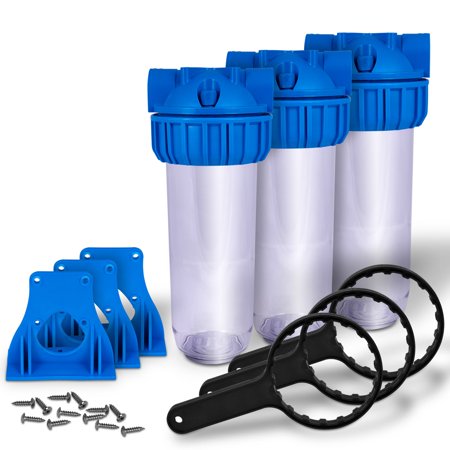
Do You Need a Big Blue Water Filter
How does a big blue water filter housing work?
A Big Blue filter housing holds big filter cartridges. Other manufacturers don’t describe their large diameter filter housings as Big Blue. Any term for large diameter housings refers to housings that operate the same way. Water enters one end and goes down through the housing. Depending on what type of filter cartridge you have, water might flow through the filter and then out, or it might go all the way to the bottom and flow up through the media in the drop-in cartridge. You can put a variety of filter cartridges inside a housing depending on what you’re trying to filter out.
Big Blue 10″ housing
What are Big Blue filter housings used for?
These filter housings are used for point-of-entry (POE) filtration, typically residential. They can be used commercially with more flow rate than a standard-size filter housing. A lot of water can flow through a large-diameter filter housing, so it’s used for a variety of applications. You can put a sediment filter, a carbon filter, or a specialty filter with ion-exchange resin or arsenic-reducing media in a Big Blue filter housing.
What do Big Blue filter housings remove?
The housing itself doesn’t remove anything. It just directs water flow around whatever filter cartridge you put inside. The cartridge does the filtering, or separating the water from the contaminants. The filter housing itself doesn’t do anything until you put something inside. And what type of cartridge you put inside determines what will be removed.
What’s the difference between Big Blue and other filter housings?
Size. Big Blue filter housings work best with point-of-entry flow rates for a whole house. Smaller filters and filter housings are used at the point-of-use (POU). The small cartridges are designed to install under the sink to filter water to a dedicated faucet or with a combination of filters in a reverse osmosis system. Filter housings are designed differently to accommodate flow rate. If you’re looking for a point-of-entry (POE) filter, you’ll want something that can withstand high flow rate. And that’s where the Big Blue housings come into play.
How do you install a Big Blue filter housing?
The Big Blue housing cap is threaded to match plumbing size. These caps are available in three-quarter, one-inch, inch and a quarter, an inch and a half thread sizes. When you’re installing the filter and housing and you have an inch and a half plumbing, make sure the cap measure an inch and a half because you never want to reduce the size from your plumbing size.
If you have a three-quarter-inch cap and an inch and a half housing, you can reduce the fitting down to three quarter with a bushing. If you’re using your Big Blue housing commercially, just connect the water into it. The cap has an in and an out. The end is the feed side. The out is the filtered side. Make sure the in and out are lined up properly since the filter housing doesn’t come on a mounted bracket. Then install your mounting bracket on to hand the filter housing on the wall.
How often should you change a Big Blue filter housing?
Every 10 years.
Big Blue filter housings are dependable and last a long time. The manufacturer suggests that you replace it every 10 years. If the housing’s been in place for 10 years, you probably should replace it. Every time you turn a faucet off while water is flowing through this filter housing, water hammering occurs. This means the inertia of the water flow stops with a force of energy. Many times water hammering causes the housing to move or flex. Eventually, the plastic could get tired of flexing and start to crack. Housings with clear sumps (body) don’t flex like the blue ones or the white ones or the black ones. Clear filter housings use a different plastic blend that doesn’t flex as well, so it cracks and fails much sooner than the polypropylene colored ones. We recommend you change a clear filter housing at least every five years so that you don’t end up with a catastrophic failure where the housing cracks and water floods.
Which Big Blue filter housing do I need?
The Big Blue filter housing has a specific application in conjunction with the cartridge that we’re going to use with it. The filter system that’s right for you could include a combination of filter housings, like one with a sediment filter and one with a carbon filter for removing chlorine or taste and odors. The filter that’s right for you really depends on your water quality.
How to Find the Best Water Filter Pitcher? Part1
Everyone want the water in your kitchen faucet to be clean, but it may contain contaminants, some of which may be harmful to your health. Well, it’s no wonder that almost half of Americans say they first filter or boil water when drinking tap water at home. According to Consumer Reports’ 2019 Water Quality Survey, the survey is based on a sample of 4,225 U.S. adults representing the nation.
The biggest complaint about drinking water is the unpleasant taste and smell. The survey also shows that in addition to the water filters built into many refrigerators, water filter pitchers are also the type most people use.
The water filter pitcher is definitely easy to use. Just fill the faucet water in it and wait for the water filter cartridge to filter the water. They are also relatively cheap, usually less than $ 40.

1. Target pollutants
Whether the quality of the filter is certified by the NSF / ANSI standard is a good indicator to measure the quality of the filter. The standard measures the ability of the filter to remove certain pollutants. Another indicator to note is whether the company is a member of the Water Quality Association (WQA).
The design of most water filter pitchers only improves the aesthetic aspects (taste and smell) of drinking water. One of the best is to find a certification body that has obtained NSF / ANSI 42 certification, not every pitcher can do it.
On the other hand, if you want to remove certain harmful contaminants, such as heavy metals, make sure that the filter has passed NSF / ANSI 53 certification. However, it is difficult to find NSF / ANSI 53 certified filters of this size. If your household water contains serious contaminants, you may need to focus on a larger, more advanced filtration system.
How Can a Whole House Water System Benefit Your Life?
Improved Water Quality, Taste & Odor – The whole house water system is guaranteed to improve the water quality throughout the entire home by providing contaminant and odor free water. For example, if you notice sediment in your water and treat your home with a whole house sediment filter you will notice clean, clear water throughout every faucet. The whole house sediment filter can prevent dirt, sand and silt from clogging in your pipes.
Improved Life of Appliances – Whole house water filters are great in protecting your home from damages caused by various water contaminants. For example, if you are experiencing orange iron staining throughout the home, a whole house iron filter can remove these stains and protect your appliances by removing and preventing heavy scale buildup. Benefit from reduced red staining, rust particles and rotten egg odor. Improved water clarity and purity without any bad odors.
Improved Health – Chlorine is a useful chemical used to treat tap water. Unfortunately, it is also a toxic chemical that is harmful for our skin and lungs. When we shower, the heat opens up our pores and absorbs chlorine from both the water and steam. A whole house carbon filter removes chlorine and provides chlorine-free showers, baths and face washes to all faucets in the home.
Softer Skin & Hair – A whole house water softener is extremely beneficial in reducing scale buildup throughout the entire home. This results in easier cleaning, softer hair, skin and brighter, longer lasting clothes. More importantly, it protects pipes and appliances from scale build up to protect any clogging from occurring. Water appliances are able to maximize their efficiency because of the reduced scale buildup from hard water.
Whole house filters remove chlorine and other chemical taste/odor, iron and scale build-up, plus dirt/sediment, making water cleaner and clearer for your whole house. If you have no special contamination issues then a whole house carbon filtration system is recommended for general multi-purpose whole house purification. If you have special water problems then you would need a whole house system dedicated to treat that contaminant. A whole house softener is recommended if you require soft water for a scale free environment and spotless glassware. Whole house filters are a big investment for your home and work effectively to protect your fixtures and home appliances. Enjoy better health and peace of mind knowing harmful contaminants have been removed from every faucet outlet in your entire home.
 sun yunda